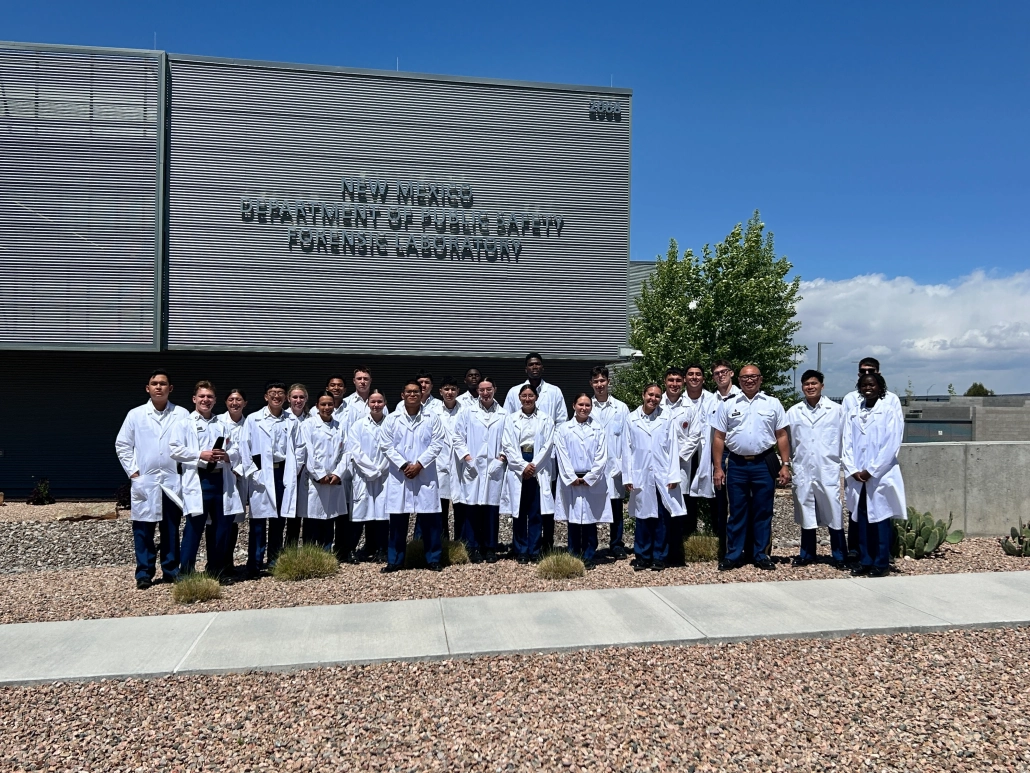
Forensic Science II and College Chemistry Cadets Visit DPS Forensic Laboratory in Santa Fe
The Forensic Science II and College Chemistry classes recently visited the Department of Public Safety (DPS) Forensic Laboratory in Santa Fe. The purpose of the tour was to bridge the gap between theoretical concepts learned in the classroom and real-world applications in the field of forensic science.
The cadets were first introduced to the Firearms section, where they observed how firearms and cartridges are examined using a bullet comparison microscope. They learned how specialized equipment, such as the water tank and bullet recovery box, is used to safely recover bullets for analysis without damaging critical markings. The cadets were also shown actual evidence and walked through the step-by-step process of how examinations are conducted. Additionally, the lab demonstrated how evidence is carefully tracked and stored before and after analysis using RFID technology, ensuring the integrity of the chain of custody.
In the Latent Print section, fingerprint analysts demonstrate how latent prints are collected using both physical and chemical methods. Cadets observed techniques such as powder dusting, chemical fuming, and the use of alternate light sources to visualize prints that are not visible to the naked eye. They were also introduced to advanced imaging systems and digital comparison tools used to analyze and match fingerprints in criminal investigations.
The cadets also participated in discussions and hands-on scenarios in the DNA section, where they learned how biological evidence is collected, preserved, and analyzed. They explored how DNA profiling is used to identify individuals and solve criminal cases. Through guided exercises, cadets were asked to determine what types of evidence should be collected at a crime scene and how proper handling is essential to avoid contamination.
In the Chemistry division, the cadets viewed an educational video illustrating the step-by-step process of how cocaine is derived from coca leaves, providing insight into the chemical transformations involved. They also had the opportunity to engage in hands-on drug identification activities, utilizing modern analytical techniques such as spectrometry alongside traditional color tests. This experience reinforced their understanding of how controlled substances are identified and confirmed in forensic laboratories.
Throughout the visit, cadets had the opportunity to interact with forensic professionals, ask questions, and gain insight into potential career paths in forensic science. The experience not only enhanced their understanding of forensic methodologies but also highlighted the importance of accuracy, ethics, and attention to detail in criminal investigations.
This field trip served as a valuable extension of classroom learning, allowing cadets to witness firsthand how science is applied in the pursuit of justice.